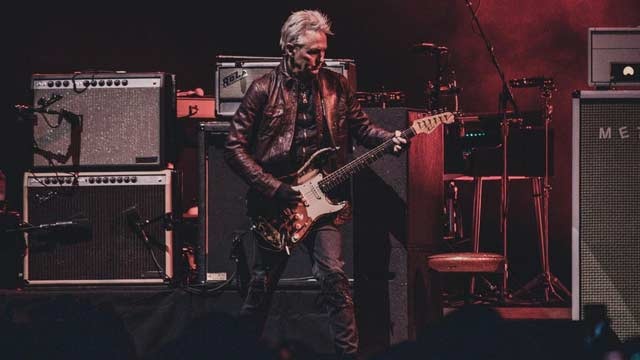
And now, you can also add “graphic novel storywriter” to his resume, with the release of Mike McCready’s Farewell to Seasons, for which he also recorded a soundtrack. With a storyline inspired by the rise of grunge in the early ’90s, both the graphic novel and soundtrack are available for pre-order.
In the discussion with AllMusic that follows, McCready talks about stepping outside his comfort zone, navigating the differences between collective and individual creativity, and the formative environment that helped shape his musical identity.
Let’s discuss the new graphic novel and “lost” rock opera album, Farewell to Seasons. How did this project come about?
“The idea kind of came from when I was in Covid. Around that time when we were all locked down. I had a couple dreams, and one was with Chris, and one was with Layne, and they were kind of eerie and strange. And I thought, ‘What was it about this? Why did everybody die in this scene? What happened? And was it worth it for these guys?’ And all these questions are coming to me, and I wanted to approach that in the context of a story of like, how do I answer that? Or, how do I how do I propose that question – in an artistic sense.”
“So around Covid, I called up Cameron Crowe, who’s been a dear friend of ours for a long time. And he’s always been a mentor to me and been very cool about giving me ideas and projects to play on – Almost Famous, for example. At any rate, it was originally for a rock opera. It wasn’t a it wasn’t a graphic novel. And I thought, ‘Okay, how am I gonna put this into a story about three different characters in a historical fiction with a fantasy element to it, and how do we play this on stage? And what does it look like? And what is the story?'”
“And so I talked to Cameron, and he kind of gave me some ideas about this thing called ‘The 11th Hour Song,’ and how the character has to make a decision at that time whether to die or not, or come back. He gave me some great ideas. So, the next day, I started writing. My singing coach – her name is Sue Carr – she said, ‘Get on WriterDuet.’ And so I got on that, and I started writing a script, not knowing how to do it. So, I did that over a period of years, and was writing songs at the same time about these characters – really to be played on stage.”
“And then throughout that, sending out the script to a couple people, and through my manager, Mark Smith, he said, ‘Why don’t you try a graphic novel?’ I hadn’t thought of that. And I’m a big comic book guy, and I’ve always got a Comic Con and all these kind of things with my kids. And I sent out the script to a couple of places, and Z2 was the one that was really excited about it.”
“And Rantz Hoseley and Josh Bernstein who run it, understood the story, and really seemed legitimately excited about it. So, I kind of went that direction with it. Went, ‘Okay, here’s the script…but I also have all these songs. I’d love to put those in the context of the story.’ Hence, now we’re gonna have the book and the record that comes along with it.”
How would you compare writing music for this project to when you present material to Pearl Jam to record?
“This project was a lot more specified and a lot harder. But I also wanted to feel it, if that makes sense. It has to have all of those elements, but it has to tell a story. With Pearl Jam, I’ll come in with a riff idea, or I’ll come in with some demos and go, ‘Hey, this could be cool.’ You never know with Pearl Jam. I’ll come up with a bunch of ideas, and the one I think is going to be really great doesn’t work.”
“And maybe Ed [Vedder] will pick something else – he’ll gravitate towards something else, the one maybe I didn’t think was as great. It’s totally. different. It’s totally different. We have five songwriters in the band, or four now, but, so you’re just trying to get your stuff in. And also help everyone else’s songs along the way.”
Why do you think so many great bands came out of the Seattle area in the late ’80s and early ’90s?
“I think…Seattle was such a small, provincial town. Y’know, Boeing was kind of the only major industry here and logging around the mid ’80s – and prior to that. And when the music scene, when I started in it, I was 12! I was playing shows when I was 12, until basically now – except for two years. So, the scene back then, when I was a kid, you’re renting out churches and skate rinks and playing with a lot of local bands. There was a band called Overlord. My band, Shadow, played with a lot. And we would do shows together.”
“But Seattle didn’t help the scene at all. There was a thing called the Teen Dance Ordinance, which if you were an artist or a band that was under 21, you couldn’t play in any clubs. You couldn’t go into them. You couldn’t do anything. And there wasn’t any anything cool, like the Vera Project – which is an all ages project here in Seattle now.”
“So, the Teen Dance Ordinance, you couldn’t go to into clubs if you were underage. And we were an underage band – Shadow was. So, you’d have to get a million dollar insurance policy and rent an off duty cop to put shows on if you were underage. It also prevented bands, big bands, from coming to Seattle. They’d go to Portland, to Vancouver. So a lot of bands that came out of here were, I think, had kind of a chip on their shoulder, because they’re like, ‘Well, fuck…what about us? Why don’t you come to Seattle?'”
“And it’s crappy and rainy, so we’re in garages all the time. So, I feel like that’s part of it. There’s a darkness up here a lot of the bands keyed into just by being from here, I think. And it was a very small scene. We all went to the same parties, so we kind of knew each other, and we would go to each other’s shows. I made you do it yourself. I guess it was good, y’know, go to Kinko’s, you print up 1,000 flyers, you book your own church show – it’s all of that stuff.”
Some people may not know this, but you have some serious heavy metal roots, right?
“Oh, yeah. I loved the New Wave of British Heavy Metal. And I played in kind of a punk-metal band called Shadow at the time, and loved Iron Maiden and loved all that stuff. But we did all originals, and we’d rehearse all the time, and we’d book our shows and play – with this scene that had happened prior to the Seattle music scene. We had quit by ’84 – at least the five-piece of the band – and then, the scene was starting to start at that time. So I felt like I missed it or something. Or I already did it, y’know? But I did come from a metal background. And I loved it – I still do to this day.”
“But I came up on Motörhead. The one thing I was saying earlier was we would go to the same shows. The punk guys and the punk-metal guys would go to the same shows and the same parties – specifically the same parties around University Ave. We’d be playing Motörhead, .45 Grave was a big one, Alice Cooper: Killer. Those three records, the punks and the metal guys could agree on, from what I recall.”
“And there’d be a keg, and we’d all sit around. Because there wasn’t a huge scene here. So you just kind of did your own thing – with people of other musical genres, I guess.”
When was the moment that you realized Pearl Jam was becoming massively popular?
“Ah, good question. Yes – when we were on Lollapalooza. It was 1992, and we were on at four o’clock in the afternoon. And suddenly, thousands of people were there – very early – and running towards the stage and screaming. And then they just kind of dissipated after that for a sec, and then they came back. But when the stage was starting to get rushed on Lollapalooza, that’s when I realized it was big. And then I started seeing tattoos of our band on people’s arms. I’d say ’92.”
I was lucky to see that Lollapalooza tour at Jones Beach Theater here on Long Island, New York. There’s actually great YouTube footage of during “Porch,” Eddie climbs all the way up a concrete scaffolding thing – way, way up high [see video above].
“He did that all the time. And I always thought, ‘Man, just don’t fall, dude.’ He never stopped doing that. And people remember it to this day.”
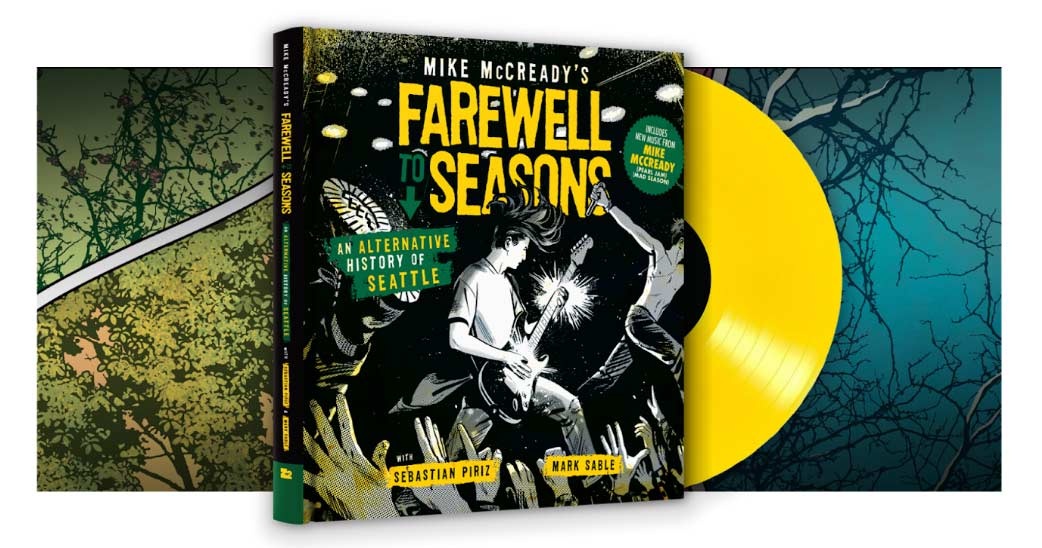
Both Mike McCready’s Farewell to Seasons graphic novel and soundtrack are available for pre-order.