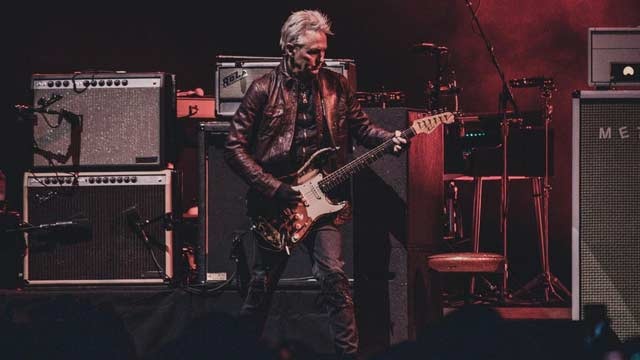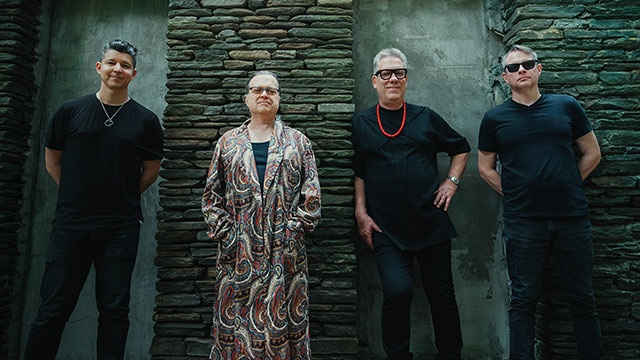
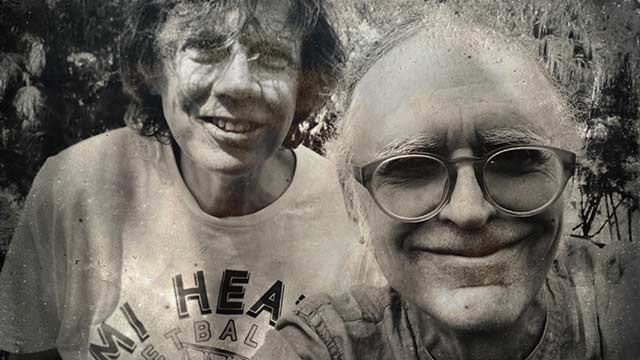
With Moore going on to be best known as a long-time member of Sonic Youth and Kramer as a producer (working with the likes of Galaxie 500, Low, Urge Overkill, etc.), it would not be until 2026 that the duo got the opportunity to work together. And as evidenced by such tracks as “Urn Burial” (a Velvet Underground-esque instrumental) and a cover of an oft-overlooked Joy Division tune (“Insight”), the material highlights a shared affinity for mood-driven minimalism and understated experimentation.
In the following discussion with AllMusic, Moore discusses how the collaboration finally took place, in addition to the early years of Sonic Youth, guitar, and an appreciation of a certain classic rock band’s early work (which may surprise you).
How did the collaboration between you and Bonner Kramer come about?
“So, Bonner Kramer is his name, but we all know him as ‘Kramer.’ He’s always been Kramer to everybody. He’s recently took on the name ‘Bonner Kramer’ in honor of his family. And he has an interesting sort of family history, which only he can tell you about. So, now he is Bonner Kramer, and was to be referred to as such, which is totally cool, but we all know him as Kramer.”
“It came about…I mean, we I’ve known Kramer since the early ’80s in New York. And he was the engineer, proprietor of Noise New York, which was a downtown studio on East Broadway. And he was the guy running it. He was like a real character, and he was a musician.”
“I knew about him as a musician because he had been playing around the experimental music scene in downtown New York with people like John Zorn and Eugene Chadbourne. And so I knew about this guy, but working with him for the first time was as an engineer. I mean, Sonic Youth did their very first demo at Noise New York, before Kramer was involved with that place, and it was up in Midtown somewhere. And then Kramer bought the place from the previous proprietor, and it became the place to go to that was affordable, especially if you’re doing kind of weird music that was really on the margins of everything.”
“And it was up like a mile high set of stairs, on East Broadway, in this building. And that was very close to Tier 3, which was a venue that we used to go to in the late ’70s. It was an infamous place. I remember he told me a story about Lou Reed recording there, when Moe Tucker was doing her sessions there, Kramer produced, and just coming up with his amp, and then buzzing the door, and Kramer buzzing him in and him looking up the stairwell and just saying, ‘Oh fuck, I got to carry my amp up these stairs?’ Lou Reed, of all people. Y’know, the inglorious glory of rock n’ roll, carrying an amp up like three flights of stairs. And that’s when I met him.”
“I would go in and out of there for different things. All of us in the band were playing with different kinds of people. And Don Fleming was living upstairs from Kramer’s studio. And I would play with different sessions that he would organize for his bands – he had a band with Kramer called B.A.L.L., that was on Kramer’s own record label, called Shimmy Disc, which still exists. And then Don Fleming had a band called Gumball – it was just pals with these guys. And then, we would record together. And like I said, Mo Tucker was up there. Half Japanese was always up there. Daniel Johnston was recording up there. So, all this kind of like weird music was happening, and we were totally into that. So, I was always working with him.”
“Then he disappeared. He did some very high profile records with, like Galaxie 500. He did beautiful records with the band Low, Alan Sparhawk…but then he disappeared. And I didn’t know where he had gone – through all the years of the beginning of the late ’90s, 2000s everybody’s lives morphed and changed into what they changed into. And we all kind of grew up and got into our 50s, and now we’re in our 60s and 70s.”
“So, about eight years ago, I was in Miami, Florida, which is where I was born, and I have family there. And I was spending a lot of the pandemic year there with my wife, Eva, and we were working on book projects. She’s a book editor and I was writing music and just finishing ‘Sonic Life’, the memoir I wrote, and I saw something online about a gentleman named Frank, and he was the first owner of Noise New York. And I remembered him – he was posting something from South Miami, Florida.”
“And I wrote to him, I said, ‘Are you in South Miami?’ By the way, I hadn’t seen this guy in 35 years. He said, ‘Yeah. What are you doing here?’ And we met at a hotel bar, and we just spent the three hours talking. He said, ‘By the way, Kramer is living in Hollywood, Florida, and he’s been here with his wife for quite a while. He took over one of his parents’ houses, and that’s where he’s been. He’s still working with the Butthole Surfers and making music with Paul Leary, and putting records out on Shimmy Disc, and Half Japanese and Daniel Johnston stuff.’ And I said, ‘You got to be kidding me.'”
“And so I reached out to Kramer, and we got together. We hadn’t seen each other in ages, and we just started hanging out, like two old guys, kind of reconnecting from the ’80s downtown New York scene. And then Kramer moved away. He moved to Asheville, North Carolina, and set up a studio there. And he wrote to me said, ‘We should have recorded when I was there.’ I said, ‘Record what?’ He says, ‘Just record music together. Why not? How come we’ve never done that?’ We had played together a few times through the ages, but just with a bunch of other people on stage making a racket, improvised noise.”
“He flew back down to Miami, set up a little mini recording situation in the home I was renting, and I just picked up a guitar or two, and he said, ‘Just go, man, go.’ And he turned it on, and I improvised. I just played all kinds of just free, open guitar music. And he sat there just kind of smiling. And then every 20 minutes, I would wind down and stop, and he’s like, ‘Oh my God, okay, let’s take a break and do it again.’ And so we did it for entire two days.”
“He took the files, brought them back to North Carolina. And about a month later, he said, ‘Okay, I put my stuff on it,’ and he sent me the files. And he just did this, like, magical mix – he played piano and bass and just different instruments, and did these wonderful mixes, and constructed songs, pieces of music as an album’s worth of songs.”
“The only identifiable piece of music was a cover of a Joy Division song, ‘Insight,’ and that was his idea. So, at the end of making all this guitar noise for him. He said, ‘Let’s do ‘Insight’ by Joy Division.’ I said, ‘I don’t know that song.’ I mean, I know Joy Division songs, but I couldn’t place it. And he said, ‘Yeah, it’s a bit of a deep cut.’ But once he started playing the bass, I recognized it. You know that bass line? [Sings] Do, do, do, do, do. Very classic. And he said, ‘Here’s the lyrics.’ I think I did it in one take.”
“I just sat in front of the microphone, and sort of did my best Bryan Ferry impersonation. If I have to sing real vocals, I sort of channel the first two Bryan Ferry solo records [1973’s These Foolish Things and 1974’s Another Time, Another Place]. For some reason, those inform me without getting too over dramatic. So, that’s what we did and we put this record together.”
“I mean, we just sort of had these ideas come up. Kramer had this photograph that he wanted to use, he had this title he wanted to use, and I was totally cool with his sensibilities with it – and we put this record out. I mean, I’m making a new record in June, which is my group, which is the Thurston Moore Group – which is me and Deb Googe from My Bloody Valentine, and two other London musicians. And we’ve been active doing this for years now. We put out like, three albums, so there’s a new album being made this June.”
“As soon as everybody settles down, Deb’s out with My Bloody Valentine right now, wait for her to come back. So that’s what I’m doing. Kramer and I were playing it at the Big Ears Festival in Tennessee next week [March 26-29, 2026]. It’ll be the first time we play together as a duo. So, that’ll be interesting. We’re just going to go for it.”
Will there be other members in the live band, or will it remain just you and Kramer?
“Just me and Kramer. And there’s a big, beautiful pipe organ, I believe, in this space that we’re using. And Kramer is going to utilize that. And we’re going to reference the music on the record for sure. But it won’t be cookie cutter. We’re gonna just take off, and we may or may not do the Joy Division song. We’ll rehearse it and see, like if we have enough confidence to do it right.”
“But, y’know, it’s Big Ears – I have like, three gigs there. I have the one with Kramer. Kramer has a bunch of gigs. He’s doing something with Pan Sonic. I’m doing a duo with Steve Shelley, who’s on tour with Bill Orcutt and Ethan Miller. So the Orcutt Shelley Miller Trio is playing. So, me and Steve Shelley will do a duo, just improvise guitar and drums music. And I’m also doing another improvised set with Shabaka Hutchings, the great avant garde, spirit jazz saxophonist from England. And we know each other – we’ve played together recently a couple of times, once with Moor Mother, something she set up, and then at Cafe OTO here in London, with Evan Parker.”
“So, that’s kind of the music I find really rewarding these days, is playing just really free improvisation. It’s a very sort of challenging music to sort of get involved with. It’s not jamming, it’s not just like, winging. It’s just like really listening to each other and creating instant compositions, like spontaneous compositions in the moment, and thinking about it as a piece of music that has a beginning, middle and end. Not just sort of some long winded jam out. So, that’s something I’ve been sort of studiously involved with for the last decade.”
How did you originally start experimenting with guitar tunings?
“I never thought of myself as a traditional guitar player, even though I loved great, high technique traditional guitar players. So growing up, I was really into Jimi Hendrix and Jimmy Page. I was really into Joni Mitchell and what she was doing with guitar. I have an older brother who’s five years older – he’s a guitar lunatic. So, him and his buddies would be playing guitar all through the early ’70s in the living room, and I would just be gleaning it.”
“I think I got into playing experimental guitar, just like when I started seeing punk rock bands, in like, ’76/’77. I was very interested in how a lot of the guitar players weren’t traditional guitar players, in the sense where they were trying to play so much like the model of Jimmy Page, Eric Clapton. Even though a lot were, I mean, Binky Phillips of the Planets was, Miki Zone of The Fast was…and I’m talking about bands from ’75/’76 in New York.”
“And then when you saw the Ramones, it was just like, ‘Oh, it’s just like, down stroking barre chords.’ But it’s creating this, like, really incredible catalog of songs that was really identifiable as a music that was unlike anybody else’s music. And it was really effective. I mean, it was so, so great. And it was also really liberating. It’s like, ‘Oh, I can actually just sort of play barre chords and it’s a be all and end all.’ And I kind of started doing that, and I would write songs as a teenager – I thought I was writing songs for the Ramones to play. I wrote a song called, ‘I Don’t Want to Clean My Room No More.’ Things of that nature.”
“And then hearing the Sex Pistols and hearing the Damned, it was just like these guys were wilding on guitar, but making really great music out of it. And I was like, ‘Okay, you can be more freer on guitar.’ But when I moved to New York, I immediately sort of got it. I got involved with hearing and seeing such radical music, whether it was music that was happening at the Kitchen Center with musicians like Rhys Chatham and Glenn Branca, seeing no wave bands like The Contortions and Mars. And these people were not employing any traditional guitar technique in their in their playing with the guitars. And I really sort of thought that’s kind of what I want to apply myself to.”
“I don’t really want to, like, learn to play ‘Eric Clapton guitar.’ I didn’t really have the desire to have that ambition towards that. I got started immediately to do different things with the guitar. And also, one of the factors was I had a nice Fender Stratocaster, and it got stolen almost immediately after moving to New York. Someone broke into the apartment and stole the guitar. They heard it. They were like, ‘Okay, there’s some guy in there with a guitar. Let’s go get it.’ And I had a couple of guitars that I bought at yard sales in Connecticut – they were cheap, crappy guitars. And that’s what I used.”
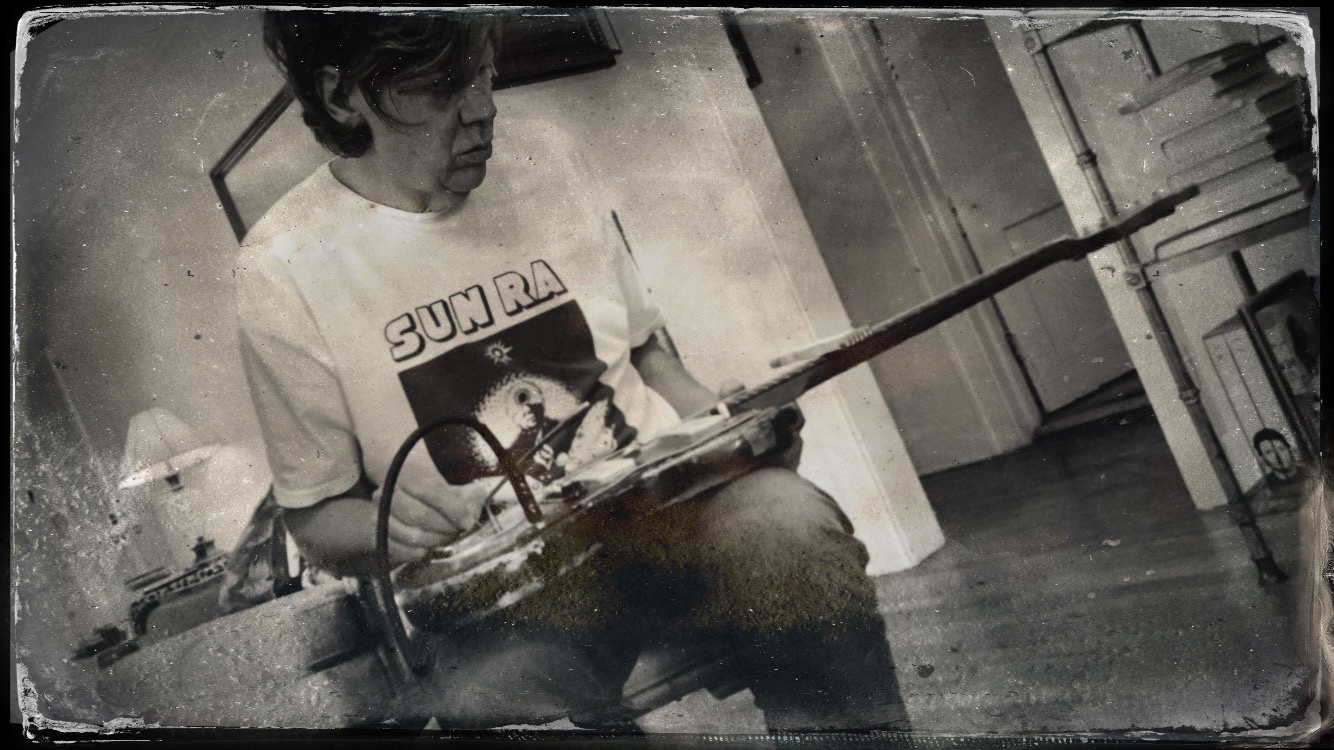
“And then, when I started playing, I played in a band called The Coachmen, and we were playing standard, sort of chordal, kind of Talking Heads/Television-influenced music. And while I was in that band in ’78/’79, I would be going to these little clubs – and that we would play at sometimes – but I would see things where people were really doing much more freakier stuff on guitar. And I would see some people just playing really free improvised guitar, where they were really expressing themselves on the guitar either noisily or not noisily. And that really attracted me.”
“And at some point, after the band that I was in, The Coachmen, broke up, I immediately started playing like that. I said, ‘I’m just gonna play free. I’m gonna open up and I’m gonna take the guitar, I’m gonna go wild on it and sort of see what happens, and try to apply that to songwriting.’ And that’s how Sonic Youth kind of started, because I started playing with this young woman named Stanton Miranda, and she introduced me to Kim Gordon, and then I started playing with another woman that I had met named Anne DeMarinis, who was the girlfriend of a famous conceptual artist named Vito Acconci, living in Brooklyn. And I started playing with Miranda and Anne.”
“And then I was introduced to Kim through Miranda, and I brought Kim into the fold, and she had a bass that she had bought, but she didn’t really know how to play it so much. So I gave her some reggae records and said, ‘Just listen to the reggae records and play along with them. That’s a bass lesson right there.’ And that’s how we started. And so I was playing with these three women, and Miranda immediately left the group, and I started using different drummers that The Coachman had had, until we had found first Richard Edson and then Bob Burton, then Steve Shelley.”
“Lee Ranaldo I had known because he was somebody who was playing music around town, and he saw The Coachman, and he became a bit of a fan. He started coming to our gigs, and I liked what he was doing. And then he started playing with Glenn Branca. And I tried out for Glenn Branca, and then I finally started playing with Glenn Branca. The two of us were playing with Glenn Branca, and we first toured Europe with Glenn Branca in ’82 or something.”
“And I asked Lee to be in the band that was happening with Anne DeMarinis, Kim and I. And Anne DeMarinis left. And so there was a bit of a hole in the band. And so we asked Lee, because we were playing in the same kind of little weird, noisy places, and that was it. There was like the three of us were the core of what became Sonic Youth.”
“And as soon as Lee joined, I pretty much got the name Sonic Youth. I mean, we did one gig with Anne DeMarinis as Sonic Youth. But it was like, things were falling apart. I could tell. And I said, ‘Well, I’m just gonna take ownership of this band, and I’m gonna use this name that has been in the back of my mind, and it’s gonna be the greatest name ever, and we’re gonna be the best experimental rock band of the world. And that’s what’s gonna happen. Nobody’s going to stop us.'”
“And so it was like, going to get Lee, boom, it just started happening. And we followed our sensibilities. We weren’t like, going out of our way to kind of sell ourselves. We just did what we did, and we certainly didn’t have any notion of becoming well known or anything. We really wanted to sort of be part of this community that we adored. Creating interesting music and being part of that.”
“And then, we had no idea how things were going to develop. Like, who was going to put a record out by us, and then the different bands that would come up after us that we kind of became associated with – whether it was Mudhoney, Pavement, Nirvana, whatever. I mean, it’s like all that stuff came later. That came at the end of the ’80s into the ’90s. But during the ’80s, it was Meat Puppets, Butthole Surfers, Minutemen, fIREHOSE, Black Flag and that whole SST scene. And then leading up to sort of the Sub Pop scene. SST, Southern California, kind of really ‘outsider,’ kind of just like post-punk, post-hardcore, kind of…Saccharine Trust was really big for us. These kind of bands.”
So it was pretty much through working with Lee that you started doing the interesting guitar tunings?
“Oh, definitely. There was a moment that even before Lee was in the group where I went to the Kitchen Center to see a retrospective of Rhys Chatham’s guitar music, which he was playing these amazing pieces of music that were just using, like, one note or one chord. And it was like, loud and it was just driving, and it was a really radical usage of guitar in rock music. But it wasn’t rock music. It was just new music, using rock instrumentation. And so I remember going to that and sitting next to Lee, and the both of us kind of so giddy with the promise of this. And I knew right away, this is really where we’re going – creating experimental music with guitars.”
“And as soon as we started, playing the guitars in any traditional aspect, they were such lousy guitars that they sounded terrible. You couldn’t play an E major chord. It just sounded out of tune, or it sounded bruised and they didn’t stay in tune. They sounded clacky and plasticky. Maybe putting a drumstick underneath the 12th fret and noting it so you can actually play on either side of that drumstick, and turning the amp up enough where you can actually rub that drumstick with another drumstick, the more serrated, the better. It created this kind of droning, kind of multi-harmonic sound – like shards of sprinkling sounds, and they’re using different implements.”
“Lee brought in a hand drill and put a put a contact mic on and sent it to his amp, instead of playing a lead guitar solo. He played that on the first song we ever wrote, which was called ‘The Burning Spear,’ on our first record [1982’s Sonic Youth]. He plays the electric hand drill for the solo. We were just establishing ourselves as a band that was going to sort of really just break completely away from what a traditional rock band was, but still honoring what a traditional rock band was. We were a four-piece. There was two guitars, bass, and drums. We all interchanged the instrumentation. It became established.”
“A few years into it, Kim became the bass player, Lee and I were the guitarists, and we had a drummer, and we became more sophisticated as players, and we became more of a normalized band than we first were, when we started. But at the same time, we were into sort of referencing great traditional rock, whether it was Grateful Dead, whether it was Creedence Clearwater Revival – these kinds of things. As well as, like, just open-ended experimental music.”
“So, we were really trying to create sort of a borderless unity with these kind of aesthetics, a band that sort of was both experimental yet straight ahead. So, it kind of allowed us to go out and be part of Lollapalooza or whatever, which is like, we were the straightest band on Lollapalooza [in 1995]. We were clean-cut. Nobody was big drinkers. There was no druggies in the band, none of that. We read books, we went to bookstores. But all the other bands, whether it’s Hole or Jesus Lizard or Pavement, everybody else is just kind of wild and wooly in their lifestyles…but their music was more ‘straight ahead indie rock.’ Where our music was never that. So, there was a paradox where we were the straightest band making this crooked music.”
I once heard a rumor that I wanted to ask: is it true that you’re an admirer of the album Queen II?
“Love it. Queen I and Queen II are like essential records for me. And when the first Queen album came out, I immediately bought it. And the American version of it’s really great, because it has that embossed sleeve. The OG UK one does not. I didn’t know that until much later, when I became much more of a record collector nerd.”
“But I loved Queen I, and I played that record to death. Brian May’s guitar playing all through that record was great. And the songwriting is just amazing. They shredded. There’s something very sort of Bowie-faye about it as well, which is cool. It was like glam. And there was something very, very ‘pretty boy’ about it. But it was shredding, it was as heavy as anything else. And then Queen II was just as good…if not better.”
“I always regret not seeing them, because I was a little too young. I was like, 14, 15, 16. And I was living in Southern Connecticut, and I knew the stuff was happening at New Haven Coliseum. Y’know, some older kids were like, ‘Yeah, we went to New Haven Coliseum and saw such and such.’ And I knew that Queen was on a bill with Mott the Hoople. And I really liked Mott the Hoople – I had the Mott album, and I thought it was really cool. And I think I had All the Young Dudes, as well. But I didn’t have the wherewithal, I couldn’t figure it out, like, ‘How do you get to New Haven?'”
“The first time I went was some friends said, ‘We’re going to New Haven Coliseum to see Frank Zappa.’ And I went. I got a ticket with them. And I saw Rick Wakeman, I went to see Kiss up at Springfield Civic Center. And Blue Öyster Cult and some of these early ’70s things. Some better than others. But what I really wanted to see was what I was seeing and reading in Rock Scene Magazine.
I really wanted to see the New York Dolls. I really wanted to see the Dictators. And then first hearing about Television, I really want to see that, and I really wanted to see Patti Smith. And finally, I did see Patti Smith in Westport, Connecticut, at the Playhouse in ’76. And by that time, I got my driver’s license, and then I started going into New York and seeing Wayne County and everything.”
“But Queen, those two records, yeah, they’re huge for me. The third album, Sheer Heart Attack, I think that was a really good record, too. But by the time Sheer Heart Attack came out, it was already too late. I was like, Ramones, Pistols, Clash, y’know? So Sheer Heart Attack was like…I remember hearing it and going, ‘Yeah, it’s really good. But it’s a little too ornate.’ Like, I’m into the Heartbreakers, y’know?”
Well that right there are all the questions I have. I just wanted to say it was great to finally speak with you, Thurston.
“Oh, cool man. I’m really happy and proud with of this record. And I think I have to doff my hat to Kramer – he did such a great job with it. I wasn’t really looking for, like, some new record of mine to be out right now. That was not on my agenda. And it just sort of came out now. And I was just like, ‘Oh, okay.’ And people started buzzing about it.”
“I put a lot of weird improv and noisy records out and cassettes all the time. So when one gets this kind of attention in that world, I was just like, ‘Oh.’ It wasn’t really on the agenda, but it’s kind of cool. That label, Silver Current, that Ethan Miller is running, I think it’s a really great label. I think he’s doing a really good job. He’s always been a good egg.”
Order They Came Like Swallows: Seven Requiems for the Children of Gaza here