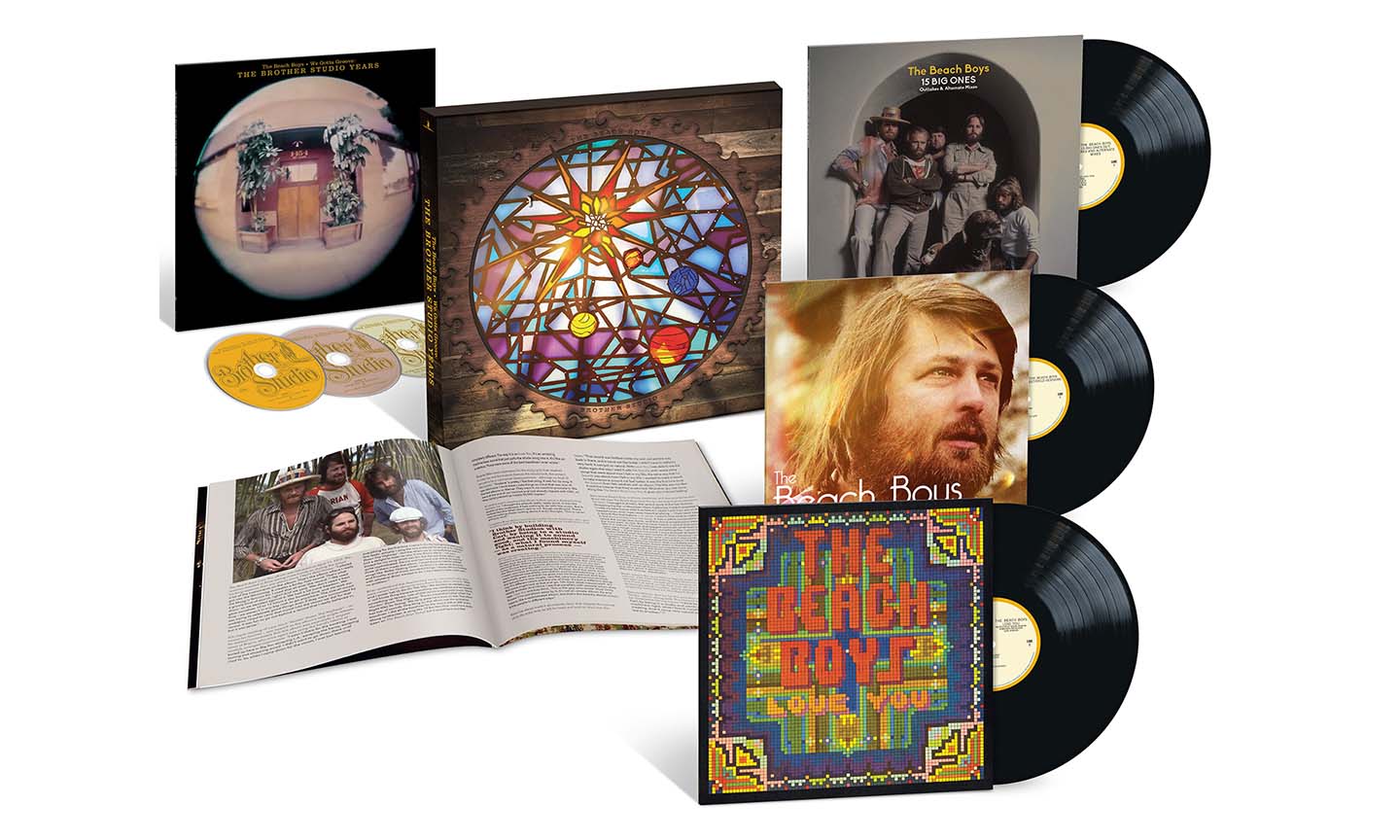
The new Beach Boys box set We Gotta Groove tells the story of the legendary band’s mid-70s, a period that saw the release of the mega-selling hits compilations Endless Summer and Spirit Of America, the band become a stadium-filling live draw and the return of Brian Wilson with 15 Big Ones, the fan favorite The Beach Boys Love You and the previously unreleased gem Adult/Child.
The set features previously unreleased tracks from the 1974-75 sessions that pre-dated Brian’s comeback, including an early, Carl Wilson-led take of Dennis Wilson’s stunning “Holy Man,” Carl’s soulful “It Could Be Anything” and Brian’s wee small hours rendition of “In The Back Of My Mind,” originally sung by Dennis on 1965’s The Beach Boys Today! There’s also a host of outtakes from Brian’s return to production duties on 15 Big Ones – including a blast through golden oldies “Shake, Rattle & Roll” and a swaggering “On Broadway” – as well as producer James Sáez’s revelatory remixes of key tracks from the album.
The following year’s Love You was the album that really saw Brian take the creative reins. He’s credited as the sole writer on 11 of its 14 tracks (he co-wrote the others), produced the whole album and played most of the instruments. The result was Brian at his most playful – all gruff vocals, fuzzed-up Moog and ARP synthesizer-led arrangements and lyrics that veered between the cosmic (“Solar System”), heartbroken (“I’ll Bet He’s Nice”) and flat-out bizarre (“Johnny Carson”). We Gotta Groove includes all of Love You, remastered by Sáez, along with backing tracks, alternate takes and vocals-only mixes. It also includes Brian’s Love You piano demos, giving incredible insights into his creative process.
When Love You was finished, a rejuvenated Brian carried on into sessions for what became known as Adult/Child. We Gotta Groove features the best of those sessions – including the stunning “Still I Dream Of It” and “It’s Over Now” – along with backing tracks, emphasizing Brian’s deft arrangements and musical vision.
uDiscover spoke to We Gotta Groove’s producers Howie Edelson and James Sáez to get the lowdown on how the set was put together.
What was the initial thinking behind We Gotta Groove?
Howie Edelson: Well, the general thinking is always, how much of the vault can we liberate? Because there’s no other band that left as much quality stuff on the cutting room floor as The Beach Boys. I mean, even with these box sets – with Feel Flows, Sail On Sailor and this one – there could be second volumes of each of them. James’ thought process is probably, “how do I make sure it sounds as good as it can?” I’m not focused on that at first. For me, it’s like Supermarket Sweep – how much of this music can we get out? I would have wanted three extra discs, and maybe one day we’ll get them – not right away, but certainly, there’s so much more.
So that’s my first thing, and also, what I love about these box sets is that we present the music as an era. So albums that were unfairly dumped on at the time get re-evaluated on their own terms. It’s not like ‘this is the new album and these are the 12 songs that you have to judge right now.’ Instead, the songs become part of a larger family, an era, and you can focus on the positive aspects of the time. I love being able to get this music together and reshape the narrative around it, making it part of almost a monument.
The earliest tracks on the set, from 1974 sessions led by Carl and Dennis Wilson, offer a real Sliding Doors moment – what might have happened had they led the band…
Howie Edelson: They were essentially piecing together the follow-up to Holland. Mike had stuff in development as well, and Al too. And they stepped back so that Brian could come back. First of all, it was amazing press. It was a perfect comeback story – it was their 15th anniversary and Brian had been somewhat debilitated creatively. It was perfect for an NBC special, perfect for People magazine.
In the short run, those albums didn’t do them any favors on the charts. A 1975 Dennis and Carl-led Beach Boys album would have been competitive with Chicago, Steely Dan and Fleetwood Mac. It would have kept them on the FM track that they had been on with Surf’s Up, Carl & The Passions and Holland. 15 Big Ones was not FM music, and it wasn’t really AM music, and Love You was neither, it was turntable music. But when you look at that stuff that was being primed, the Pacific Ocean Blue tracks that were done during these sessions – “Rainbows,” “Pacific Ocean Blues,” “River Song” – and you put that with what Carl and Brian were doing, it would have been better than Holland, I think, but that wasn’t to be.
When 15 Big Ones and Love You didn’t sell – although “Rock And Roll Music” [the lead single from 15 Big Ones] was the soundtrack to the bicentennial in America, that long, hot summer of ’76, along with Frampton and “Silly Love Songs” by Wings – their FM cred, their album-oriented cred, was gone, and the live act became the universe. But it was a miracle that Brian came back and we got as much material as we did. We got 40 songs in a year and a half. That’s incredible.
How do you think Brian would feel about We Gotta Groove being released?
Howie Edelson: I know from my conversations with Brian that he was incredibly proud of this period and would have been excited. He equated Love You to Pet Sounds several times and in a lot of ways. So I know he would be thrilled, and he would be thrilled by the Adult/Child material reaching the masses.
These guys would do a lot of work and leave a lot of work behind. And even on albums they released, three of those songs would be in the setlist for three months, and then they’d be out. So Brian didn’t remember a lot of these songs. I had to sing him “That Special Feeling” [solo piano demo included on We Gotta Groove] for him to remember it. He was like, “That’s a great song!” And I said, “It’s yours!” That was about 10 years ago.
Mike doesn’t remember a lot of it either. Years ago, I said, “What do you remember about cutting ‘Running Bear’ [15 Big Ones outtake finally released on We Gotta Groove]?” He goes, “I have absolutely no memory of cutting ‘Running Bear’.” So now, the joke is, he’ll be like, “Well, yeah, I must have done it, because that is me.”
Mike and Al get a huge kick out of things that they were told were junk having such a big following now, especially when it’s young people, like John Brode, who’s our archivist. I mean, John could feasibly be their great-grandkid, and he’s as in tune with it as someone would have been in 1977. There’s no nostalgia, there’s no kitsch to it. When I talk to him about this stuff, there’s no age difference. If you’re a true believer, and this is your thing, it’s an even playing ground.
The set also tells the story of the band’s short-lived Brother Studio…
Howie Edelson: I really learned about it from Ed Roach [photographer]. There’s not been a lot written about the studio, and it wasn’t around for that long. Ground was broken in ’73 and the first Beach Boys work that was done there was mixing for Beach Boys In Concert that year. The board wasn’t in the control room at that point, it was kind of a makeshift thing. And the first non-Beach Boys recording done there was the backing vocals for Elton John’s “Don’t Let The Sun Go Down On Me.”
Ed Roach’s wife, Trisha, ran the studio. She was the secretary, the mother superior, the heart and soul of that place. So from Ed, and from John Hanlon [engineer], I got the feeling of what this place was. I basically got the vibe of what it was for Dennis. These three guys were playing a certain role for Brian in the morning, and then staying up all night with Dennis while he brought his whole life into the studio and recorded non-stop. People think it must have been this crazed lunacy, but Dennis was always making music there, as well as whatever else was going on. There weren’t nights where the studio was dark, because he was always recording. And I personally think – after hearing what’s there – that everything that Dennis Wilson ever laid down on tape deserves to be released. Even his doodles, I’m that amazed by it all.
Does any footage recorded at Brother Studios exist in the archives?
Howie Edelson: Ed shot footage there for the “River Song” video. And there was footage from Brother that was used for the NBC special [The Beach Boys: It’s OK, 1976], when Brian’s playing “I’m Bugged At My Old Man” with Carl and Dennis on backing vocals. There’s also a little bit in the Malcolm Leo documentary, An American Band [1985] – really good quality footage of them doing “Surfer Girl” around the piano. There’s more of that, several takes. You get to see the room, but it’s very lit up with Hollywood lights, whereas you want Brother to be that dark, carpeted, mellow vibe.
How does it feel to be continuing the work of those Brother Studio engineers – Stephen Moffitt, Earle Mankey, John Hanlon and Jeff Peters?
James Sáez: Obviously you get to peek behind the curtain to see how things were recorded, and see the difference in how different engineers worked. But I’m also trying to be really respectful of the amazing work that these guys did. As soon as I pull up a mix, I listen to all the rough mixes, outtakes, pieces that we have from the time. You listen to things like how something was panned, or there’s some fascinating instrumentation on these tracks, like, “I would have recorded the drum kit like we normally do, but there’s no hi-hats. Why is that?” Or “here’s this snare drum that’s recorded through an amplifier with reverb printed into it, and it’s distorted and crunchy” – you have to listen to that and go, “These guys were all working on this. This is what they were driving toward.” Let’s shine a light on that. So you have to follow their lead, because they’re the closest thing to the source.
So I tried my best, and I’m sure I failed in places and succeeded in places at emulating what they were trying to work toward. Because I think these guys, Mankey and Moffitt and Hanlon, I’m so excited to sit with them and ask them questions. I have all these questions – like, there’s this chorusy, flangy guitar that shows up in four or five songs, and I would say that it is the exact same sound in all those songs. So I’m like, “You guys must have stumbled upon this sound and been like, ‘that is so cool, we’ve got to find another spot for this.’” So I’m fascinated at asking them questions about how they did that, because that’s where I came from. I put microphones in front of people every day and to me, that’s the most fun, most instantaneously visceral part of it – where things can change in a second, and you have to be absolutely present. I think these guys just had a blast. This was their sandbox and their playground, and we’re lucky to have had that happen at that time, or we just wouldn’t have this music.
It must have been great to give them their dues in the book that accompanies We Gotta Groove?
Howie Edelson: I wanted to make sure that every one of these engineers that recorded this music was involved this time. That hadn’t been the case before. These were the guys that made that studio what it was. If Dennis had walked in and they weren’t there, it wouldn’t have gotten done. So when I was able to make that decision, that’s how we proceeded. You know, it doesn’t take anything away from me to talk about how brilliant someone else is.
How did you approach the remixes on this set?
James Sáez: One of the cool things is that there’s this huge depth of knowledge – Howie, Alan Boyd, John Brode – people have been working on this material for decades in some cases. And I embrace their ideas on what this material needs and where it should be going. You really have to listen, you have to stop and pay attention, and you have to be respectful of how they talk about these things, because they’ve been in it for so long. That’s the first thing you do.
And then once you sink into it, you realize that this box set is really three different sets of music that were recorded in three different ways by different engineers. The common thread is they were all done in this same studio, or very close to the same studio, which was a breath of fresh air for the band, and led to a resurgence in them playing all together in a way that they hadn’t done in a really long time. So that was something I wanted to make sure was highlighted. I wanted to make sure that Dennis playing drums on these records was something that was forward, not tucked in a corner. I wanted to feel like he was a big part of this, because he was such a big part of this studio and this recording time period.
The other thing is that 15 Big Ones is a much more lushly recorded album, with more instrumentation, more session players, things like that. I wanted to be respectful of that shift, not hide that, but be like, ‘OK, we can make a song like “On Broadway” big, because it was built that way, and that’s what the band intended.’ The Adult/Child material is very different. It’s very raw, almost punk rock, in a way. It’s more of what the songwriting process is at the beginning. And that’s something that’s really exciting too.
Another thing that’s so cool about this box set is that you get these cassette demos where you get to hear Love You in its most primitive form, when Brian is still trying to figure out tempos or he’s having a little trouble with the song structure. They’re really sketches, which I always love, being able to see that next to the finished product is always really cool, because you can bounce back and forth and be like, ‘Wow, I wouldn’t have come up with that.’
What made you decide to remaster the Love You album rather than remix?
Howie Edelson: I thought that I was listening to a remix. I swear to God, I called James and I was like, “I thought there wasn’t going to be a remix?!” When they usually say something is remastered, it’s usually just louder. It’s deafening. Finally, this was a remaster that lived up to its name. I was blown away, because it was a night and day experience. I was not expecting to spin the Love You disc on this box set more than twice upon completion, but that’s not been the case.
How did you make that happen, James?
James Sáez: I can’t tell you [laughs]! No, the truth is, I did some pre-work on it, just to clean things up. There was a lot of front and back stuff that I wanted to take care of before it got to mastering. I’m also a bit of a cinematic guy, so I wanted things to be wide and kind of soft, but yet muscular. I’m trying to find the right adjectives for it.
I give a lot of credit to Robert [Vosgien], who did the mastering. We had a long conversation about what direction it was going to go in, what I wanted to retain from those older mixes, and what I would love to shine a light on. He’s worked on Beach Boys material before, so he got it. I also told him, “Look, if you’re mastering and you need something changed, or you want a vocal up half a dB, or there’s something that you hear that you don’t think is right, call me anytime, 24/7, and I will get you a version within hours.” So once again, this is really a group effort. I give all these people huge credit for making sure that we’re doing our best work when it’s our turn to step in and take the reins. It was a pleasurable, non-conflict thing. It was really just fun and creative. I think when you have that experience, the final product sounds that way too.
How did you set about working out a sequence for the set and for the Adult/Child sessions in particular?
James Sáez: We had dozens and dozens of long conversations, not just Howie and I, but with Alan Boyd, who is such a big part of why this is here and why so much stuff has been here for decades. We moved things around for a long time. I was really picky at the beginning, being like, I want a list of how songs are going to go into each other. There was a sense of, we’ll figure that out as we go. And I was like, no, no, I want to mix it in order.
I did the stuff on disc one early – things like “Hey There Mama” and “Clangin’” – because I wanted it to feel like it had this evolution. My first concern was that I don’t want it to sound like, here’s a whole time period, and then it jumps to a completely different time period. Or I’m going to put a mix that was done in 1975 right next to a mix that I’m doing in 2025 with a technology that’s going to make it sound really different. So I pared down how I mix stuff. I changed the outboard gear. I studied the list of outboard gear that was at Brother Studio and talked to the guys about what was there.
Getting into the Adult/Child material, we moved stuff that was on the main chunk of that. Then there were things we mixed that we didn’t use, when we said, “I don’t think that’s going to fit.” And we had long conversations about what fits with those sessions; what connects those sessions and this other work so that we can put them together.
We spent six or seven months going back and forth. I went over to what was Western Studios and played this stuff through the speakers in Studio Three, where Pet Sounds was recorded. And then everybody was like, “Wow!” There was a motivation then, a feeling that you’re on the right track.
There were a lot of mixes that I finished, and then two months later, I would come back and change a little bit, just because I knew now something else was going to be before it and something else was going to be after it. So I would go back and make alternates of those mixes to better reflect that, thinking I don’t want to lose momentum, or I want to make this softer, because it’s going to go into something that’s more dynamic, and we’re going to have a shift here. How do I ramp that into the next chapter of this book? And that stuff takes time.
How excited are you for people to hear We Gotta Groove?
James Sáez: I think the scariest moment in this whole process was sending all the mixes and all the music to the band. We can all love it, but ultimately, making the artists themselves feel confident is so important. I always feel like I’m making a suit for somebody else and want them to feel as confident in it as possible. You want them to be able to walk into a room in that suit and feel like, I’m the man. And you can put little pieces of your flair in it because they came to you for a reason, but ultimately, you’re a support person to try to make that thing, which has already been fantastically successful, shine. So that was my big moment, to hear that they thought it sounded great, that was a big hurdle.
And it’s exciting to see what the fans think. I don’t think you’re ever going to make this fanbase completely happy, and I’m fine with that, but I want to make them excited. This might sound weird, but how picky and grumbly they can be sometimes is something that honestly really impresses me, because it shows how much they care and how important the content is. If they didn’t care that much, we wouldn’t have these conversations. These guys really dig in deep, and feel personally connected, and it’s a part of their DNA. So to see them digest it, that’s when you get to sit back and understand that you spent less time with your family than you would have liked, but now it’s justified in some way!
Are there any plans for further Pet Sounds releases?
Howie Edelson: Pet Sounds will be commemorated this year. That’s all I can say.
Buy The Beach Boys’s We Gotta Groove: The Brother Studio Years now.