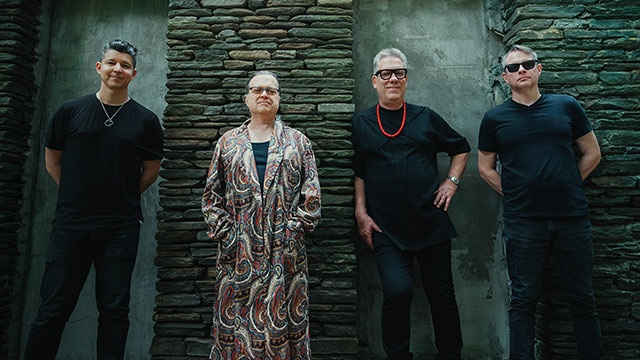
Now celebrating 45 years as a band, the Femmes are once again on the road, revisiting the songs that turned them into cult icons – even if many of those tracks, including the enduring “Blister in the Sun,” were never traditional chart hits.
Frontman Gordon Gano spoke with AllMusic about the band’s ongoing anniversary shows, the surprising ways fans interpret his lyrics, and why some of the group’s darkest songs receive the biggest reactions live.
How has the 45 Years of Violent Femmes Tour been going? Will more dates be added?
“It’s interesting how tours are defined. I think of them in maybe smaller bits, where I think of them as different tours, but somebody could take a longer view of it and be like, if it’s a 45th anniversary with the group, it could be like any touring we’re doing this year could be I guess thought of in some respect. I don’t think of it like that.”
“I think of it like we’re on a run now that’s finishing up in about two days, and it’s been going great. And then we’re under discussion for some other shows. I think there may have been a couple confirmed, but maybe they’re not announced yet. So, that sort of thing. But we’ll definitely be doing some more playing through later this year.”
When you sing a song like “Blister in the Sun” today, do you try to reconnect with the mindset you had when you first wrote it?
“That’s a good question. The answer is absolutely no. I don’t think of…I’m aware of thoughts, feelings, other things that would have gone into any song that I’ve written, including ones like ‘Blister in the Sun’ and others from many, many, many years ago. I feel like I’m aware of that, and I can maybe tap into some of that energy. But more it’s like I’m not thinking in any nostalgic way, because I’ve sung these songs over all these years, it doesn’t ever take me back, say, to a certain point in time. Even though I’m aware of that.”
Has a song ever surprised you by becoming popular when you thought it was minor or too personal?
“Well, I could say every single one, and there’s some truth to that. But then that’s counterbalanced by when we were more regularly putting out albums, and then, between ourselves and maybe a record company had been like, ‘Well, this we’ll go for as a single.’ And I think I – and we in the band – always thought that those songs were going to be more popular than they ended up being.”
“Now, some of them didn’t become hits, but then became what Brian Ritchie has dubbed, ‘We don’t make hits, we make classics.’ And that we’re never on the charts, but over time, certain songs of ours just become part of something where people love it. People love certain songs, and how so many people know the song, but it was never a hit – such as ‘Blister in the Sun’ was never a hit song. Which surprises a lot of people.”
“But then there were other songs over the years that we thought were going to become more popular, and either that maybe there just wasn’t something in the song itself to grab people and/or other industry things and other priorities, and the shifting music business made it where it never really worked out that way.”
“But I recently had just said something at a show, saying, ‘This next song, I liked the song – we all liked the song – but I’ve always been surprised how many other people in our audience really love this song.’ It just seemed like it would be maybe fewer people that would feel as passionately about it. And that’s great. And that to some degree would be the case with all of those songs.”
I’m curious, what song you just mentioned?
“I thought that might be the follow up question! A song called ‘Country Death Song,’ where I’m playing banjo. It’s a long story of this incredibly terrible thing, and the banjo is a featured instrument. And, it seemed like there’s going to be people that really like this, but the response it gets is bigger – and consistently – more than I would have thought.”
Which Violent Femmes songs are most fun for you to play live?
“Well, let’s see…that can of course shift from night to night, as far as what just catches a certain thing. But I think in general, it would be songs that we have structured in them sections where it’s not a specific solo that somebody’s taking, which we do in plenty of songs, but there’s group improvisation. So, when there’s complete free playing and free improvisation that we could do at any time, and sometimes we do, but there’s certain songs that that’s part of how either on the original recording and/or just how it’s developed over all the years that we have this.”
“So to me, that’s the most fun, where I don’t know exactly what I’m going to play, and no one knows exactly what anyone’s going to play. And that that is absolutely the most fun. On our first album, a song called ‘Confessions,’ and it’s much more of a guitar solo, but then over so many years, that’s really turned into group improvisation on that song. Also a song called ‘Black Girls,’ which was recorded with a lot of improvisation in an instrumental section. And we do that live, as well. So those are the two that come to mind. And then say, sometimes in a big improvisation, I might pick up a different instrument or switch instruments. So for me, that’s a lot of fun.”
What song of yours do you think people misunderstand the most?
“I think that thankfully, most people don’t focus too much on the words. But I think that that song I mentioned, ‘Black Girls,’ is certainly open to it. Somebody showed me something online where somebody had these just absolutely – to me – crazy ideas about that song, that were so wrong and so bad. And I never would have thought of any of that, and it’s just all wrong. But that’s what somebody thinks, including mishearing some of the words, and then writing them like that’s what they are.”
“Or another time, somebody found me in some hotel someplace, and said how much my songs – this is an interesting twist – meant to them, and how it gave them so much encouragement and so much strength for what they have to deal with in their life. And then they said, ‘But I just want to check with you, just to make sure, even though I know,’ and then they told me what it was that they had to contend with in their life. And they wanted to just to make sure, because it’s all in my songs, that I’m dealing with the same stuff. And it completely shocked me. I was like, ‘I’m none of what they thought I was’.”
“So that even went beyond just one song. That was sort of like a whole overview of all of them, and I tried to handle it because I really appreciated that this person got so much from the songs. And so, in some way, it’s not that – it’s untrue. It’s just I hadn’t thought of all of it in that same way. So that was just sort of a larger view.”
“But oh, we mentioned ‘Blister in the Sun.’ The song had been out for 10 years or more than 10 years, and I was talking to somebody that I’d met randomly, and I was enjoying the conversation. And it came up something about that song. And then they’re like, ‘Well, you know what the song’s about. You wrote it.’ I was like, ‘Well, what do you say the song’s about?’ And they were like, ‘No, you know, you wrote it. You know what that’s about?’ ‘Why are you saying it like that? What’s that song about?’ And then he finally said, ‘Well, it’s masturbation.’ And that was the first time I’d ever heard that. And he found that hard to believe, because ‘everybody’ knows that song’s about masturbation. I was like, ‘What‘?!” [Laughs]
“So that might be the biggest because…and I have heard it since then. Maybe this person was correct that everybody knows what that song is about, and the person who wrote and sings the song never thinks about that, and that isn’t what it was about. In fact, even somebody in the band thought that’s what it was about, because they heard me talking about it, and they were like, ‘Wait a minute. What is that song about?’ So, I don’t know.”
“But I think that there’s a lot of room for hearing a song and taking it how somebody wants. So, for the most part, I don’t get upset about that. But I’m usually not looking online – it was just somebody showed me that one thing that was just really bad. It was not okay. Usually, I’m pretty I’m pretty open though, like, ‘How are you taking the song?’ kind of thing.”
Which Violent Femmes album do you feel is the most underrated and why?
“There’s some that I could maybe contemplate, but the one that I could talk about in the best way would maybe be the second album, Hallowed Ground. Though I think it’s probably not the least appreciated now, but it certainly was when we came out with it. It was such a departure from our first album with the kind of songs and the approach on the songs that a lot of people didn’t care for it.”
“In fact, our record company disliked it so much they didn’t…this was long time ago, so the main thing was having a poster to put up in record stores. And they wouldn’t do one. And then found out later, they deliberately did nothing for the album, because they wanted to teach us a lesson – not to make music like that. So, even our own label disliked it so much. And other people did, as well – because the first album was very ‘rock’ in its approach, or kind of stripped down more punk, even with the acoustic instruments being used a lot and all. And the other one expanded into country and gospel and jazz. All kinds of different things.”
“Now, the one thing that I’ll say is that over the years, I’ve even had people say it to me, ‘I didn’t like that album when I first heard it or when it first came out, but over the years, I’ve grown to really appreciate it and really like it a lot.’ Also, there’s people who have always been fans of it. And, songs we liked in the group. For a long time, that was our favorite album, so we would just keep playing so many of them in concert, live. So, I think over all these decades, they’ve gotten a real response – including that song, ‘Country Death Song,’ which opens up the album.”
“Another thing I think is interesting that most people wouldn’t know is that we had all those songs – I had already written them, and we were already playing them in the band. And Brian Ritchie had the idea with the first album, ‘Why don’t we focus and streamline and make it more of a rock album? And then we can do more of the folk and gospel and all the other kinds of music on our second album.’ Because it’s funny – we’re an unsigned band, and in some respects, have nothing going for us, and we’re already planning multiple albums! And how we’ll do our second album, not our first album. But that’s how it worked out. And it was a brilliant idea.”
“I still think of that album, although now there’s no doubt ones that came years after, which have less attention from everyone – including myself. Even though, when I hear them, often I go something along the lines of, ‘That’s not as bad as I was fearing it was going to be’.”
What artist influenced you in a way that listeners probably wouldn’t recognize in your music?
“The first that pops in my head is Sun Ra. Sun Ra was a big influence on our band from the very start. And that would not occur to most people, because it was the recordings, but also, the live show. And the way that he would do his live shows, he would often either march in or march out with his ‘Arkestra,’ and if it was a club, go in between the tables and go all around. And we started doing that at different times. I think started doing that back in the ’80s, and then over all the years, occasionally we’d do a march.”
“And even recently, we’ve done a march at some different times – coming from the back of the house and marching through the audience to get up on the stage and start our show. So, that’s a very specific Sun Ra thing. But there’s so much about improvisation, and about the show. Most people would not think of that connection, I think. But it’s there in a strong way.”
What were audiences’ reactions like to the band early on?
“It depends on how early on. Very early on, ignoring or making faces or trying to get away or just saying things, conveying, ‘You guys suck.’ So, that was early on. In fact, we were playing out on the street. We called it ‘playing on the street’ – we didn’t know there was a word for it, called ‘busking.’ We only heard that some years later. And in Milwaukee, where we were, no one was doing that at that time. Maybe somebody does it now, I don’t know. But we were doing that because we couldn’t get any place anywhere to let us play. So that eventually, it is like, ‘We don’t want to keep rehearsing. We’ll just go out on the street and play’.”
“And then – you’ve probably heard the story, and it’s all true – that the Pretenders were doing a show. They saw us, and they had us come in and play about three tunes before they played, because they thought we were great. It’s like, ‘Well, everybody tells us we’re no good, but we think we’re really good. And now we found somebody who agrees with us, and they’re the Pretenders!’ And it didn’t lead to anything. In fact, when we were announced from the stage, we got booed.”
“So, it was only years later when we had an album out, we were touring across the country and doing all the punk rock clubs where if somebody had a fanzine or something and talked to us, we were able to tell them this wild story – the night we met and then opened up for the Pretenders. But it didn’t lead to a record contract or touring or anything. But eventually, when we got there, we had a fun story, and it was an amazing experience.”
Do you agree that bands like the Violent Femmes helped pave the way for what happened in 1991 – with alt-rock becoming massively popular?
“I feel like almost I’ll say, ‘Sure. Why not? I’ll take that.’ Like, I was given a selection on a menu. And they’re like, ‘This is our special today.’ And I’ll be like, ‘Yeah, alright, I’ll try that.’ I have no idea. But it’s possible. I guess if you’re asking that, yourself or somebody else thinks that that’s a possibility, yeah, sure.
I absolutely feel that way, because it seems like people try to make it seem like Nirvana came out of nowhere, and alt-rock was suddenly popular. But I know in late ’80s/early ’90s there were bands like the Violent Femmes and the Pixies and even the Cure that were kind of paving the way, and that were popular before Nirvana.
“Well, you’ve convinced me…so yes, definitely. [Laughs] And I got to give a little note too, they were still playing and going strong I think at that time, was the Ramones. We had a couple of times – amazing – that we were able to play with them. And I’ll always remember that.”
Are there any standout memories of that playing with the Ramones?
“Yes. We opened up for them – we were playing at the 9:30 Club, the old one in Washington, DC, which is a very iconic place. And somehow, we had gotten that gig to open up for them. And I’m thinking this was in the 80s. And when we were done playing, Joey and Johnny came into the dressing room and said, ‘We wanted to come here to say hi, because most of the bands that open up for us, they suck. But you guys don’t’.”
“So, they made the point of coming to our dressing room just to say hi and to let us know we don’t suck and they appreciate that. I even get little chills right now just telling you. It’s like, what an amazing thing. That was so great.”
On top of that, it’s become known in later years that Joey and Johnny weren’t even really speaking at that point. So for them to do that together is definitely quite an accomplishment.
“Yeah. You know what? They probably came in, but they were probably coming in separately. I don’t recall them actually interacting at all, so that’s probably true. They still weren’t saying or doing anything. And maybe each one independently thought to do that, and then they thought, ‘Oh, he had the same idea,’ I guess. But that was great.”